 SoQu.xyzPost. Earn. Grow.
Social quests,
settled on-chain.
SoQu turns marketing budgets into verified engagement. Agentic AI proves the post, zero-knowledge proves the metrics, and money lands in a bank account in seconds. To the creator using it, none of that is visible — it is simply an app that pays.
- V1 Protocol
- Live on Base Mainnet
- Mobile App
- Final stages of development
- Raise
- $100K USDC · 0.5% lifetime protocol fees
Brands waste billions. Creators wait months.
A $24B industry runs on screenshots and trust. Bot followers are endemic, there is no proof of authentic reach, and the money moves through as many intermediaries as it can find.
For brands
30–40% of budget never reaches a creator
Platform fees, agency margin and payment processing eat the spend.
Bot followers are endemic
No verification of authentic engagement at any scale that matters.
No proof of authentic reach
Manual review does not scale; screenshots are not evidence.
Escrow adds friction and cost
Payment processors and escrow services tax every campaign.
For creators
30–90 day payment terms are standard
Creators finance the brand's marketing campaign with their own cash flow.
Inconsistent deal flow
Micro-influencers at 10K–100K followers are structurally underserved.
No transparent pricing
No standardised compensation framework anywhere in the market.
Platform lock-in
Reputation is trapped inside whichever platform issued it.
Where the budget goes
Total take rate
Platform fees, agency margin and payment processing.
5% to create a campaign, 5% to withdraw to fiat.
Time to money
Settlement latency
Creators finance the brand's campaign out of their own pocket.
Escrow releases the moment the proof validates.
Agentic ZK-powered verified social campaigns, on-chain.
Not a blockchain company — a marketplace that uses AI verification, cryptographic proofs and programmable money because nothing in the legacy stack can do the job. All of it runs out of sight: users sign in with an email and get paid to a bank account.
AI zero-knowledge verification
Agentic cryptographic proof of real engagement. A creator proves “I have >10K followers” without ever exposing the exact number or their audience composition.
hover to see what stays hidden →
Instant payouts
Money in a bank account in seconds. Escrow releases the moment verification lands — no 30-day terms, no working capital requirement, and no crypto to figure out first.
Peer-to-peer matching
Direct creator-to-brand matching with no agency in the middle taking a cut of the work it did not do.
Pay for performance
Only verified posts get paid. Campaign funds sit in on-chain escrow until the proof clears.
Not a blockchain company — a marketplace that happens to need cryptography to work. Every component below exists because a legacy system could not do the job.
One campaign, from escrow to settlement.
Five steps. No intermediary holds the money, no human reviews the post, and nobody waits thirty days to be paid.
Verified across
Campaign creation & escrow
A brand specifies requirements — follower range, content type, platform, duration — and deposits campaign funds into the on-chain SoQu escrow. Funds can be withdrawn or the campaign cancelled at any time.
Discovery & auto-matching
Creators browse campaigns matching their niche and follower count. An auto-matching algorithm connects creators to relevant campaigns based on audience fit. No subscription, no paywall — influencers come to you.
Post & agentic verification
The creator posts to Instagram, TikTok, YouTube or X. An AI agent verifies the post against campaign requirements — follower counts, content, engagement metrics, video length — through authenticated platform API access.
Zero-knowledge proof generation
A ZK proof is generated confirming the creator met every requirement — without revealing the underlying private data. The brand gets cryptographic certainty; the creator keeps their metrics private.
Settlement & reputation
The instant the proof validates, payment releases from escrow. The creator sees their balance go up and taps withdraw — to a bank account through the integrated offramp, or on-chain if they prefer. Reputation updates for both sides.
Worked example
Brand X launches a health product
Turn one marketing budget into multi-platform, multi-layered engagement.
Product Review Campaign
- Min. 10,000 followers
- Reel & TikTok, 30 seconds
- Campaign ends in 1 month
Daily Brand Mention
- Low requirement tier
- Rate scales with verified reach
- Runs in parallel with the review campaign
Escrow lifecycle
Campaign funds can be withdrawn or the campaign cancelled at any time — subject to a 5% cancellation fee that routes to $SOQU buybacks.
The user never knows any of this happened.
Everything cryptographic in this deck is invisible from inside the app. There is no wallet to install, no seed phrase to write down, no gas to buy and no chain to choose. You sign in with an email and money lands in your bank account.
Words that never appear in the app
The entire crypto vocabulary, absent.
Not hidden behind an advanced menu. Absent. A creator can use SoQu for a year without learning a single one of these.
No wallet to install
Embedded wallets are provisioned silently at sign-up. Nothing to download, nothing to back up, nothing to lose.
No crypto to acquire
Creators never buy a token to get paid in one. Balances arrive already funded from campaign escrow.
No gas, ever
Transaction costs are absorbed at the protocol layer. A creator claiming $1 receives $1.
Cash out to a bank
The integrated fiat offramp means the last step of the journey looks like every other payout app.
The chain is the settlement layer, not the product.
This distinction is the whole strategy. Investors get an on-chain guarantee — an immutable revenue share no one can alter. Users get an app that behaves like every other app they already use. Neither side has to compromise for the other, and the addressable market stops being “people comfortable with crypto” and starts being “people with a following”.
This is not a weekend build.
The moat is not the idea. The moat is that verified engagement requires a zero-knowledge proving system, a live EVM protocol carrying real escrow, and an agentic verification layer — three disciplines that cannot be prompted into existence.
Cost of one zero-knowledge verification
per platform, per user
Every test run, every regression, every integration attempt burns real money. There is no free local mock of a proving system.
The cost of being wrong, repeatedly
Every iteration is metered.
Verification cost scales linearly with attempts. Development is attempts. There is no way to get the circuit right without paying for every version that was wrong.
A single afternoon of debugging
One integration test suite
A serious pre-launch QA cycle
and that is only the proving cost — before contract deployment, audit, platform API access, or a single line of application code.
Why it resists replication
You cannot prompt your way to a proving system.
A landing page can be generated in an afternoon. A zero-knowledge circuit cannot. There is no local mock, no free tier, and no way to iterate without paying per attempt in real cryptographic work.
Layer on live escrow contracts holding other people's money, an agentic verification layer authenticated against four social platforms, and a fiat offramp carrying money-transmission obligations — and the cost of a serious attempt is measured in quarters, not sprints.
The moat is not the idea. The moat is the bill.
ZK verification is expensive to even attempt
Zero-knowledge circuits cannot be stubbed out. Each verification costs roughly $0.40 per platform per user in real cryptographic work. Developing against them means paying, per iteration, for the privilege of being wrong.
Closed and open source, deliberately split
The SoQu protocol is a combination of closed and open-source smart contracts. The open surface invites an ecosystem to build. The closed surface is where the verification economics live.
V1 is deployed, not diagrammed
The custom EVM protocol is live on Base Mainnet with the full stack integrated and tested. Deployed contracts carrying real escrow are a different artefact from a repository.
First mover in a protocol category
Comparable to how Uniswap pioneered AMMs in DeFi — being first on a decentralised EarnFi protocol compounds through network effects, on-chain reputation and developers building on the infrastructure.
What a fast follower would need to rebuild
Everything below, before their first campaign settles.
Built on proven infrastructure, not promises.
Four layers, each carrying a specific obligation. The protocol is deployed on Base for low cost and established security — and the architecture is chain-agnostic.

Opacity Network
Agentic ZK verification layer
Zero-knowledge proofs verify social metrics without exposing private data. This is the verification blockchain layer the protocol settles proofs against.

Due Global
Crypto ↔ fiat payment rails
Global payments for developers. Creators cash out from USDC to a bank account, with the compliance surface handled at the rail layer.

Embedded Wallets
Invisible onboarding
No seed phrases, no extensions, no bridge tutorials. Users sign in the way they sign in to everything else, and a wallet quietly exists behind it that they never have to think about.
SoQu Protocol V1
Custom EVM contracts on Base
Escrow, verification hooks, fee logic and revenue share, deployed on Base for low transaction costs and established security. Chain-agnostic by design.
Key innovation
Zero-knowledge proofs verify social metrics without ever exposing private data.
Why a public blockchain at all
Neutral settlement layer
Neither the brand nor the creator controls the escrow, which eliminates counterparty risk from both directions.
Immutable audit trail
Every campaign, proof and payout is permanently recorded for regulatory compliance and dispute resolution.
Deployed on Base (Ethereum L2) for low cost and established security — but the architecture is chain-agnostic, allowing multi-chain expansion.
A large, fragmented market with no verification primitive.
The market is highly fragmented with massive information asymmetry between brands and creators. No participant currently holds a verification primitive.
Influencer marketing
Industry size (2024)
Social commerce
United States alone
Creator economy
Creators worldwide
Our target
Micro-influencers
10K–100K followers — structurally underserved by every incumbent platform.
DTC brands
Health, beauty and consumer tech verticals seeking authentic engagement.
Web3 projects
Crypto-native teams that need community activation now and understand the rails.
The wedge
Start with crypto-native brands and creators — lower friction, existing demand, an audience that already understands the value proposition — then expand to mainstream DTC on the back of proven case studies.
Because the product hides its own infrastructure, the mainstream expansion needs no education campaign. The addressable market is everyone with a following, not everyone comfortable with a wallet.
Infrastructure pricing against agency margins.
A 10% total take rate versus 30–40% for incumbents — a durable pricing advantage with minimal operational overhead behind it.
Protocol fee on campaign creation
Charged to brands
Reduced by RPG rank progression, NFT buffs and $SOQU holdings.
Fiat withdrawal fee
Charged to creators
Reduced by rank progression. Crypto withdrawals are always 0%.
Campaign cancellation fee
Charged to brands
Prevents escrow abuse. Proceeds route directly to $SOQU buybacks.
Crypto withdrawal fee
Creators
Direct on-ramp fees TBD. Everything else on-chain settles free.
Pricing advantage
Total take rate versus incumbents
Healthy margins survive the discount because the operational overhead of a protocol is a fraction of an agency's.
The EarnFi model
No subscription fees. No credit card paywall. Users do not pay to access the platform — they earn from day one. This removes onboarding friction entirely and is why creator CAC stays in single digits.
Retention mechanic
RPG progression system
Raiders and Guild Managers level up through platform activity across nine ranks. Higher ranks unlock lower fees, and upper tiers require progressively larger $SOQU holdings — a retention mechanism and a token sink in the same mechanic.
Rank
Effective fee
Mechanics
Token
$SOQU utility
Utility that exists whether or not anyone is speculating.
Fee discounts
Holding $SOQU reduces protocol and withdrawal fees at every rank tier.
Buyback pressure
Campaign cancellation fees route directly into $SOQU buybacks.
Tier gating
The highest discount tiers require larger holdings, creating structural demand.
Governance
Community governance over protocol upgrades following the token launch.
Low acquisition cost, immediate monetisation.
Creators monetise on day one, which is why acquisition stays in single digits. Brands cost more to win and are worth an order of magnitude more.
Customer acquisition cost
What it costs to win each side
Targeted social ads, crypto community partnerships and referral incentives. Low CAC justified by immediate monetisation — creators earn on day one.
B2B sales, initially targeting crypto-native projects for lower friction, then expanding to DTC. A single brand generates multiple campaigns.
Lifetime value
What each side is worth
4–10 campaigns per year at $50–100 per campaign, at 5–10% protocol fees.
10:1$100K–500K annual campaign spend at a 5% protocol fee.
5:1Target LTV/CAC: 10:1 for creators and 5:1 for brands within the first year.
per platform, per user
The one meaningful technical cost
ZK proof generation runs approximately $0.40 per platform, per user. This one-time cost is offset by eliminating ongoing fraud detection and manual review expense entirely — the thing every incumbent still pays for, every month, forever.
Network effects
The growth flywheel
Five loops that each make the next turn cheaper.
Creator liquidity → brand attraction
More creators means better matching, higher campaign success rates and broader reach.
Brand campaigns → creator monetisation
More brands means more earning opportunities, driving creator engagement and retention.
On-chain reputation → switching costs
Immutable reputation scores compound. High-reputation creators unlock premium campaigns.
Frictionless onboarding → lower CAC
The EarnFi model removes every paywall, dramatically reducing acquisition cost.
RPG progression → retention
Rank-based fee reduction makes leaving expensive and staying compounding.
Built, deployed, and pointed at a launch date.
The protocol is not a proposal. V1 is on Base Mainnet with the full stack integrated and tested — what remains is shipping the app and seeding the first campaigns.
Current status
Launch strategy
Genesis Campaign
$5KSeed initial creator liquidity by running our own campaign — using the platform for exactly what it was built for.
Token airdrop
Reward early participants, build initial liquidity and trigger network effects inside the ecosystem.
Web3 brand partnerships
Crypto projects need verified community activation now, and already understand the rails.
Expand to mainstream
DTC brands and traditional marketing, carried in on proven case studies.
The product
Four screens from the app in final development.
Rank progression, live campaigns, per-platform requirements and a wallet that cashes out to USDC or a bank account. The RPG surface is the retention mechanic, not decoration.
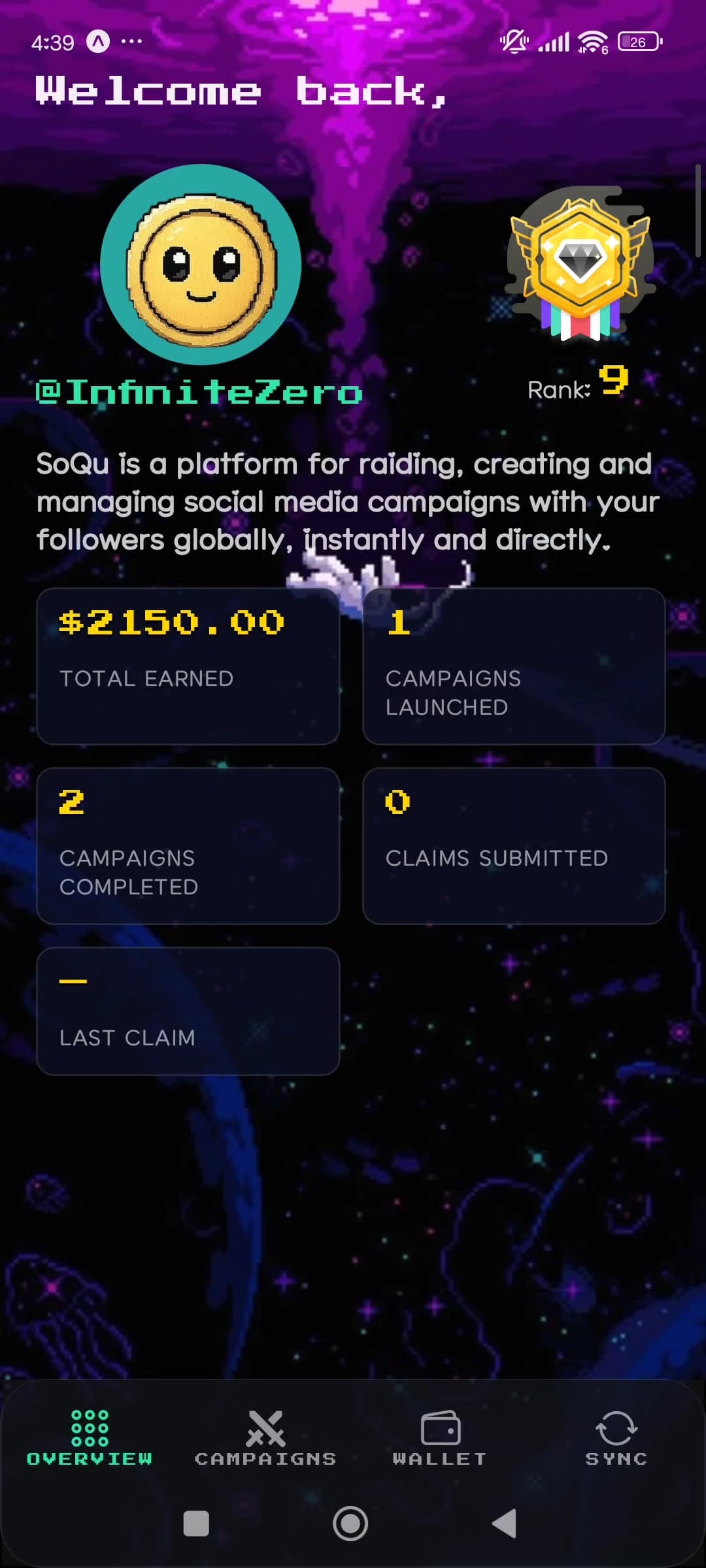
Overview
Rank, lifetime earnings and campaign history. Progression through Rank 1–9 is what drives fees down.
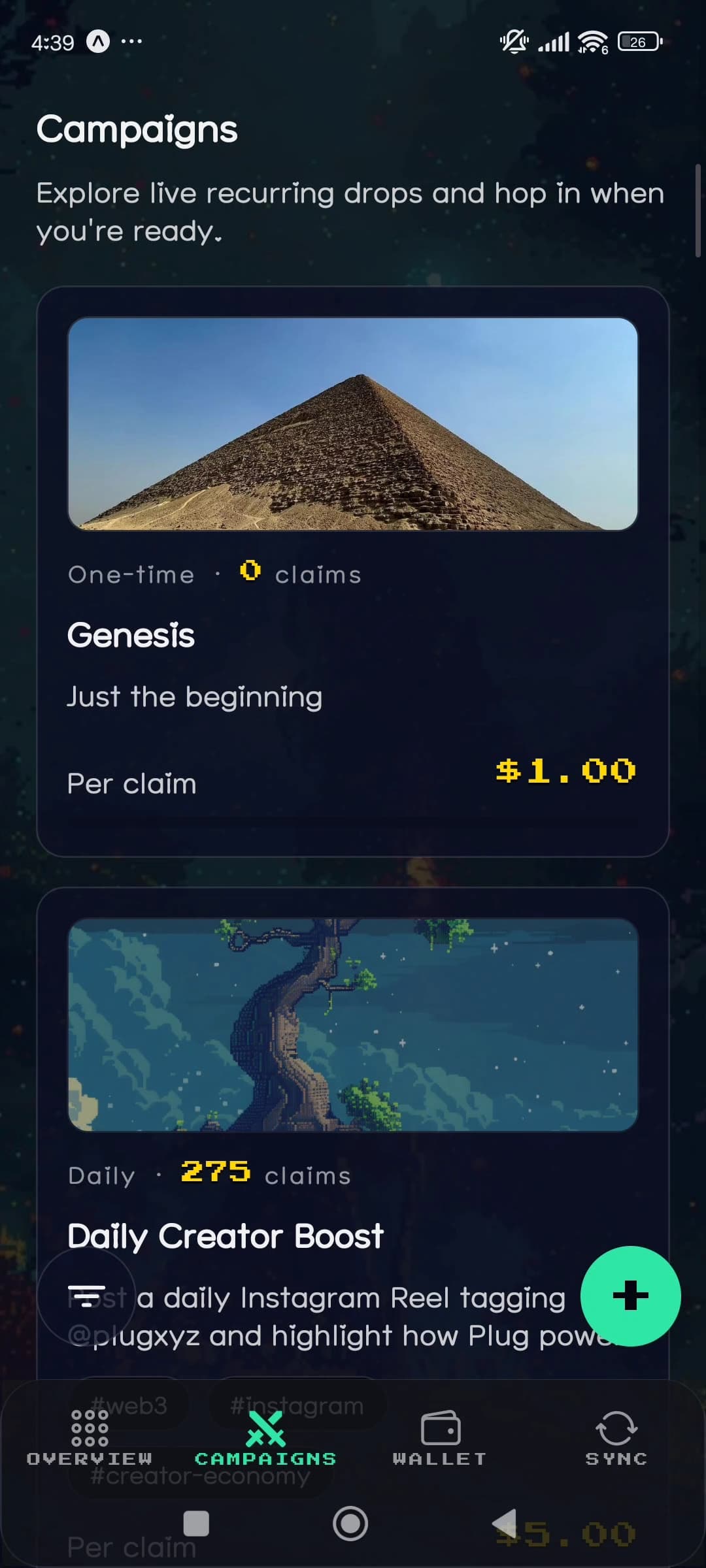
Campaigns
Live one-time and recurring drops with per-claim rates, browsable by tag and niche.
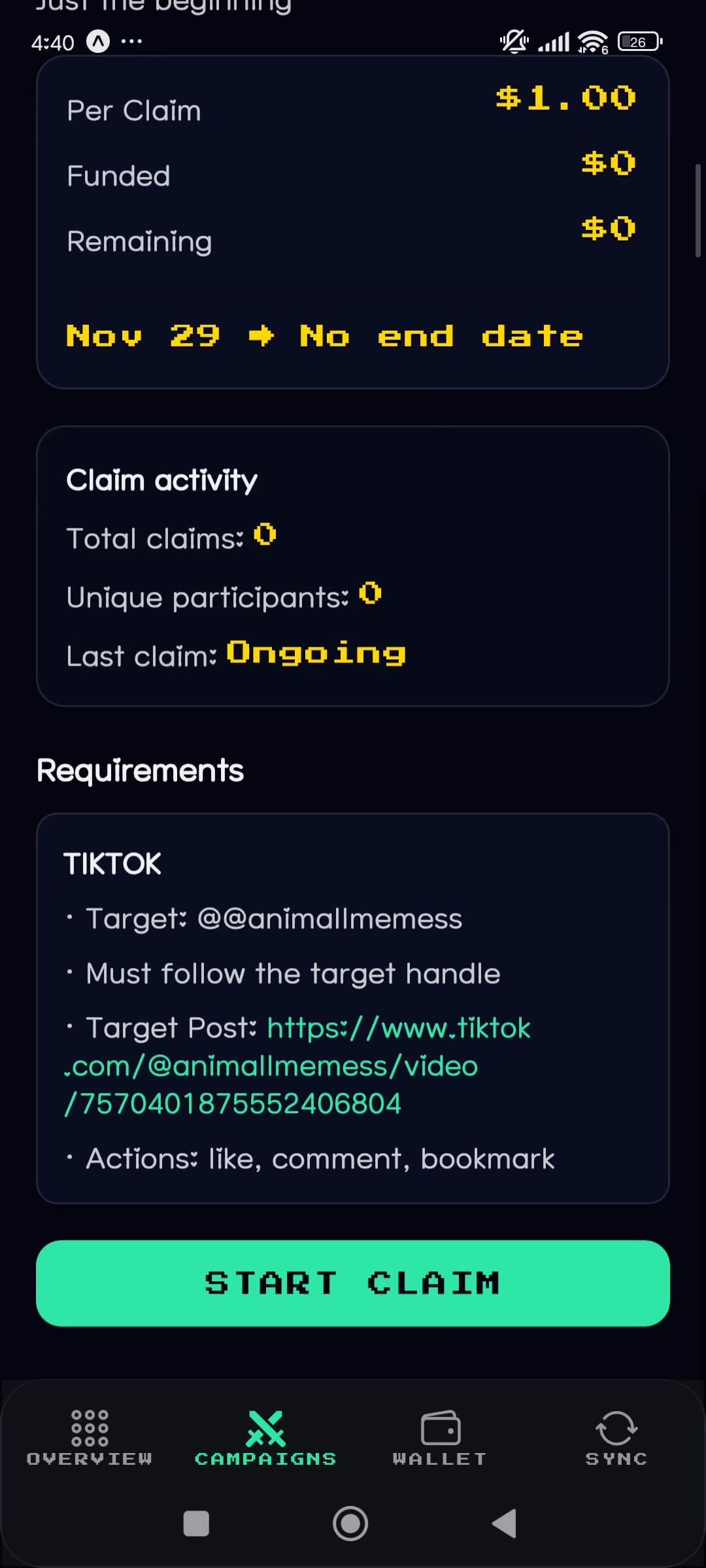
Claim
Per-platform requirements, escrow funding and remaining balance — visible before a creator commits.
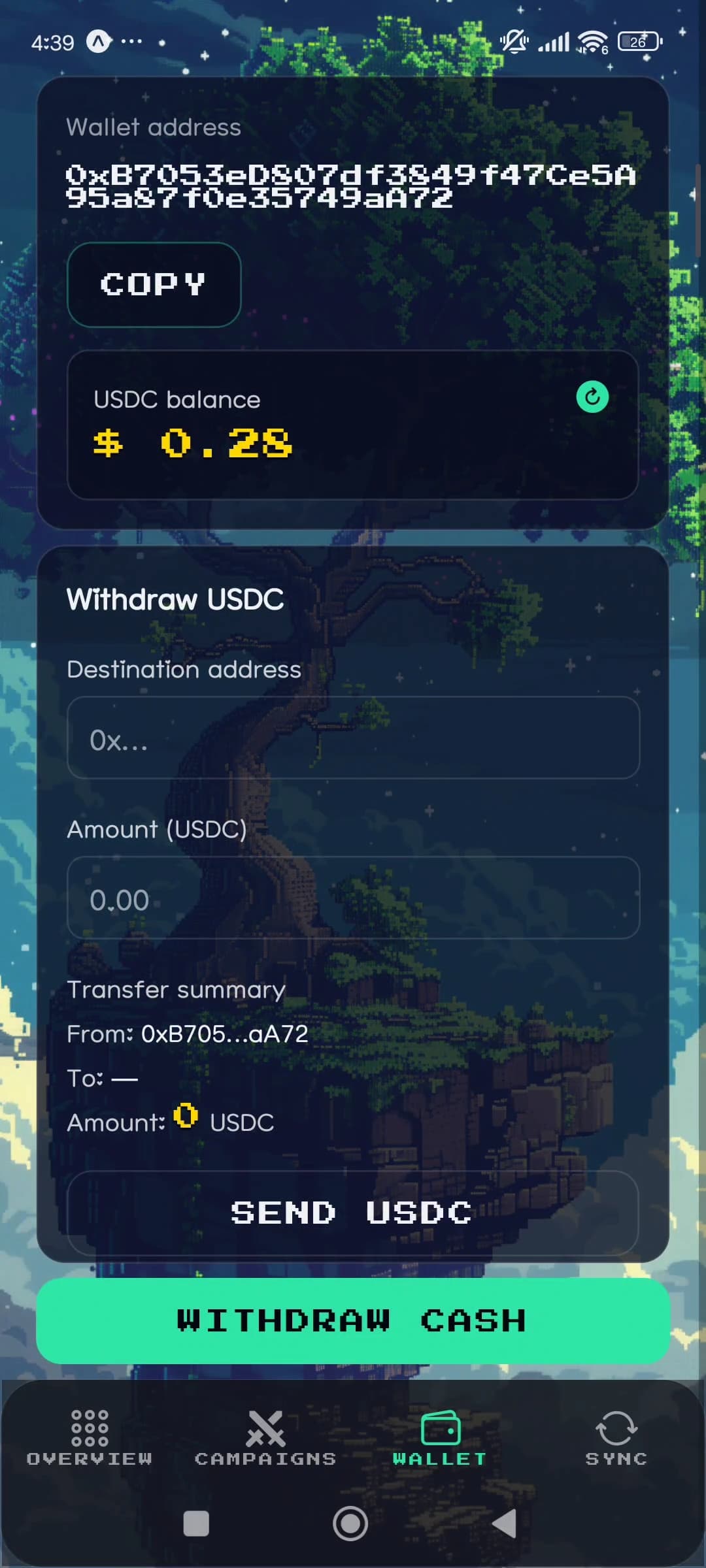
Wallet
USDC balance with an on-chain send at 0% and a fiat cash-out through the integrated offramp.
Go-to-market
The road to protocol layer.
Establish SoQu as the indispensable protocol layer for all social media campaigns — the industry standard for verified social engagement.
Platform Launch
DTC brands in health, beauty and consumer tech, plus up-and-coming creators for initial market penetration. Build case studies demonstrating ROI, fraud elimination and instant settlement.
Token Launch
Expand to mainstream direct-to-consumer brands. Airdrop to early participants creates community and reduces effective CAC.
Multi-Platform & Multi-Chain
Launch the web application alongside mobile. Multi-chain deployment for lower transaction costs and broader accessibility.
Open Protocol
Open-source portions of the protocol and initiate ecosystem grants for developers building on the infrastructure.
Why we win.
Six advantages, none of which an incumbent can adopt without dismantling the business model that currently funds them.
Only AI + ZK verified platform
Agentic ZK proofs eliminate fraud at the protocol level rather than policing it after the fact.
Instant settlement
No 30-day payment terms. No working capital requirement for creators.
A Web2 product
Sign in with an email, get paid to a bank. No wallet, no seed phrase, no gas — nothing a creator has to learn before earning.
True peer-to-peer
Direct to influencers and users. No agency, no middleman, no margin skim.
On-chain reputation
Portable trust that travels with the creator across every campaign and platform.
First movers, live
A unique on-chain protocol already deployed on Base Mainnet, not a whitepaper.
Head to head
SoQu versus the incumbents
AspireIQ · Grin · CreatorIQ
Diligence
Risks, and what we have done about them
Stated plainly, because you would find them anyway.
Platform API dependencies
Multi-platform support removes the single point of failure, manual verification fallback exists, and we are building relationships with platform partnership teams.
Regulatory uncertainty
Stablecoin payments reduce volatility exposure, the fiat offramp integration handles money transmission compliance, and the protocol is designed to be regulation-agnostic.
Cold start problem
The genesis campaign bootstraps creator supply, the crypto-native initial market has existing demand, and RPG mechanics plus token incentives drive early adoption.
Incumbent response
First-mover advantage compounds as users build on-chain reputation and developers build on the infrastructure. Incumbents also carry a business model conflict — high fees fund their operations.
Protocol development risk
V1 is already deployed and tested on mainnet, the architecture is modular for iterative improvement, and the open protocol approach creates ecosystem lock-in over time.
Your share, at three levels of protocol volume.
A 0.5% lifetime revenue share, hard-coded into the contract. Select a scenario to see how it scales.
Post token launch
ROI timeline
Projected breakeven at $10M cumulative protocol volume.
Approximately 2–4 months at target growth rates. Distribution is automatic and settles to your investor wallet in USDC, in weekly batches.
The instrument
$100,000 USDC
for 0.5% of lifetime protocol fees
Projected breakeven at $10M cumulative protocol volume — approximately 2–4 months at target growth rates. Figures are monthly unless stated.
Where the $100K goes.
Sixty percent finishes the product. Ten percent proves the contracts are safe. The rest buys the first users and the evidence that the model works.
for 0.5% of lifetime protocol fees
Hard-coded into the protocol smart contract. Immutable, automatically distributed, and paying from the day the protocol launches.
Immutable revenue share
Your share is hard-coded into the smart contract. It cannot be altered, diluted or revoked by anyone — including us.
Automatic distribution
USDC distributed directly to your investor wallet on protocol settlement, in weekly batches.
Revenue from day one
You start earning as soon as the protocol launches. No cliff, no vesting on the revenue share.
Founding token allocation
Included in the founding team token allocation and vesting schedule at the future distribution event.
Strategic advisor role
A seat shaping protocol governance and ecosystem growth as SoQu expands.
No dilution, no governance overhead
Pure passive income. No cap table complications, no operational obligations.
Shape the future of social engagement.
SoQu is a marketplace that leverages AI verification, cryptographic proofs and programmable money to eliminate fraud, cut costs and repair the user experience of an entire industry — while looking, to the people using it, like an ordinary app. The protocol is live. The economics work from day one. The only thing left is scale.